
UPI limits: published, unpublished, and owed
There is no single UPI limit. There is a tier that depends on what you are paying for, a bank ceiling underneath it, and a figure for daily use that nobody publishes at all.
18+ only. This site is not NPCI, not the RBI, not a bank and not a casino.
The ceiling depends on what the payment is for
Three figures, and the one that applies is decided by the category of the transaction rather than by the size of your account.
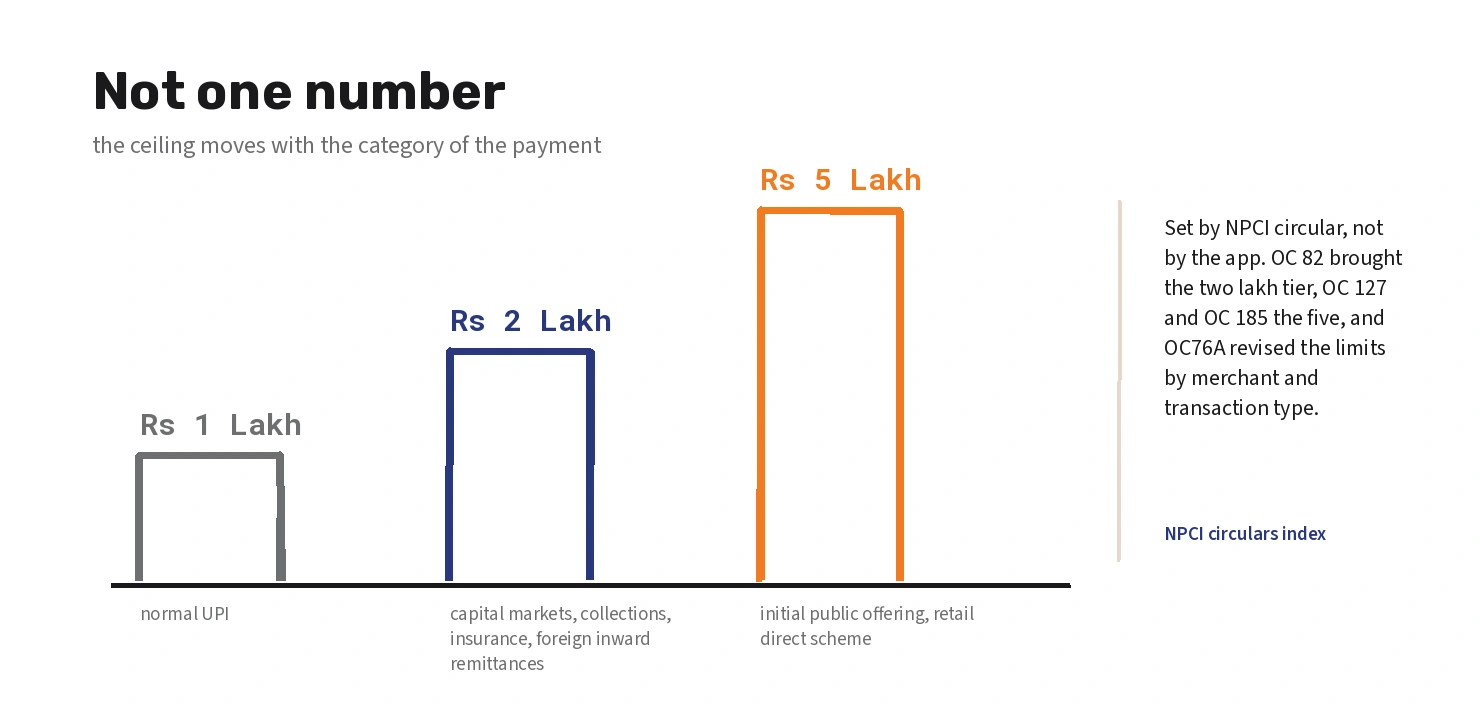
| Tier | Where it applies | Set by |
|---|---|---|
| Rs 1 Lakh | Normal UPI | NPCI, per transaction |
| Rs 2 Lakh | Capital markets, collections, insurance, foreign inward remittances | Circular 82 |
| Rs 5 Lakh | Initial public offering, retail direct scheme | Circulars OC 127 and OC 185 |
These are not app settings. The circular index on NPCI’s own site lists them as separate instruments, including one headed «Revision in transaction limits based on Merchant & transaction types». That title is the honest summary of the whole subject: the number moves with the merchant and the type, and it moves by circular.
The daily figure nobody prints
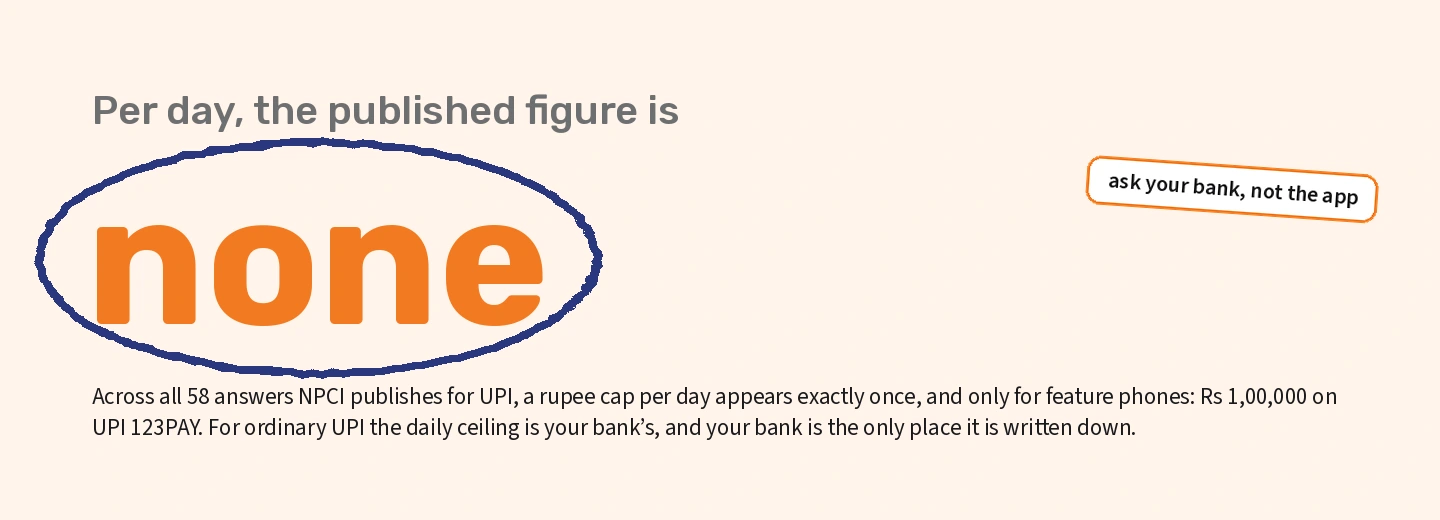
Fifty-eight published answers about UPI, and a daily rupee cap appears in exactly one of them — for feature phones.
Which means the answer is at your bank
A daily ceiling does exist in practice, and it is set one level down from the system. The place it is written is your own bank’s schedule, and that is the only source worth quoting for it.
A deadline exists, and so does a price for missing it
This is the most concrete rule in the whole subject and the one most often repeated wrongly.
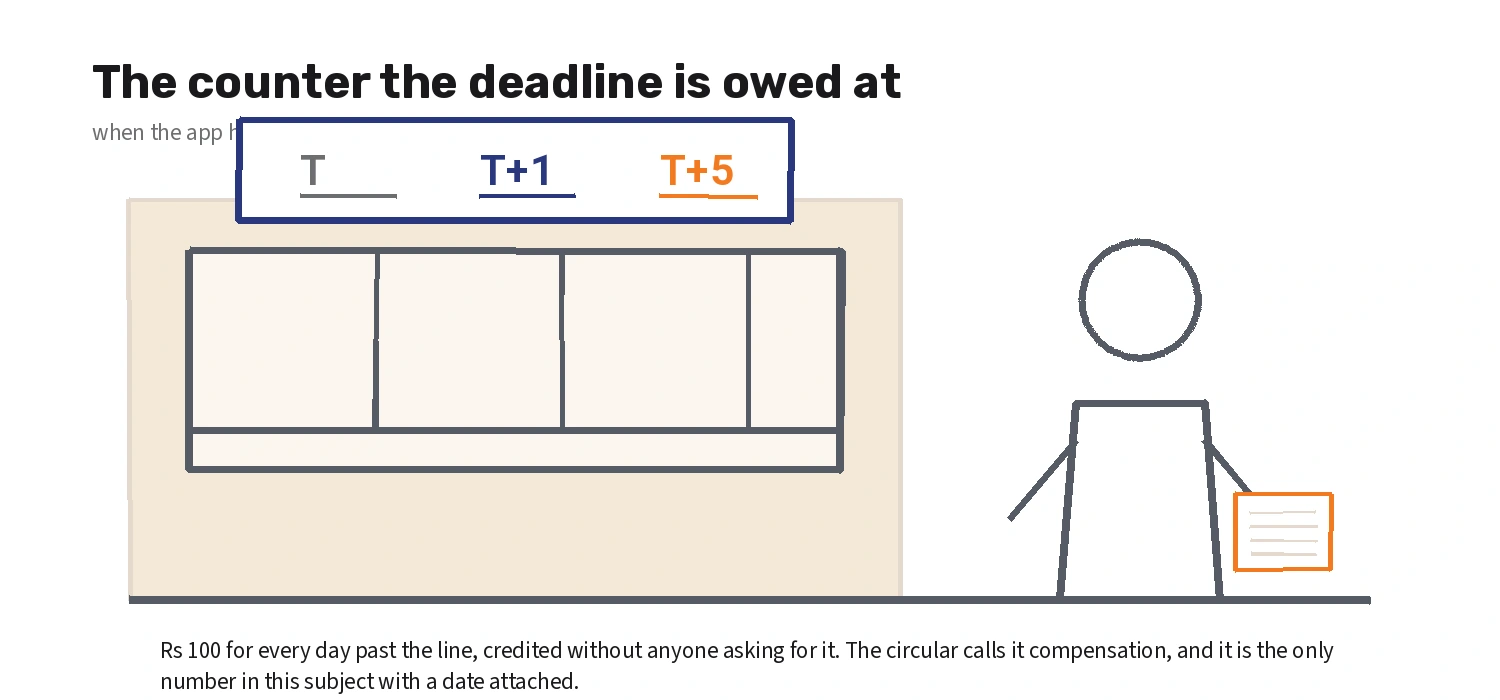
- A decline reverses by itself
NPCI: UPI «provides for real time reversals for declines and amount would be transferred back to the payer account immediately». Most failures never become a case at all.
- Debited and not credited, person to person
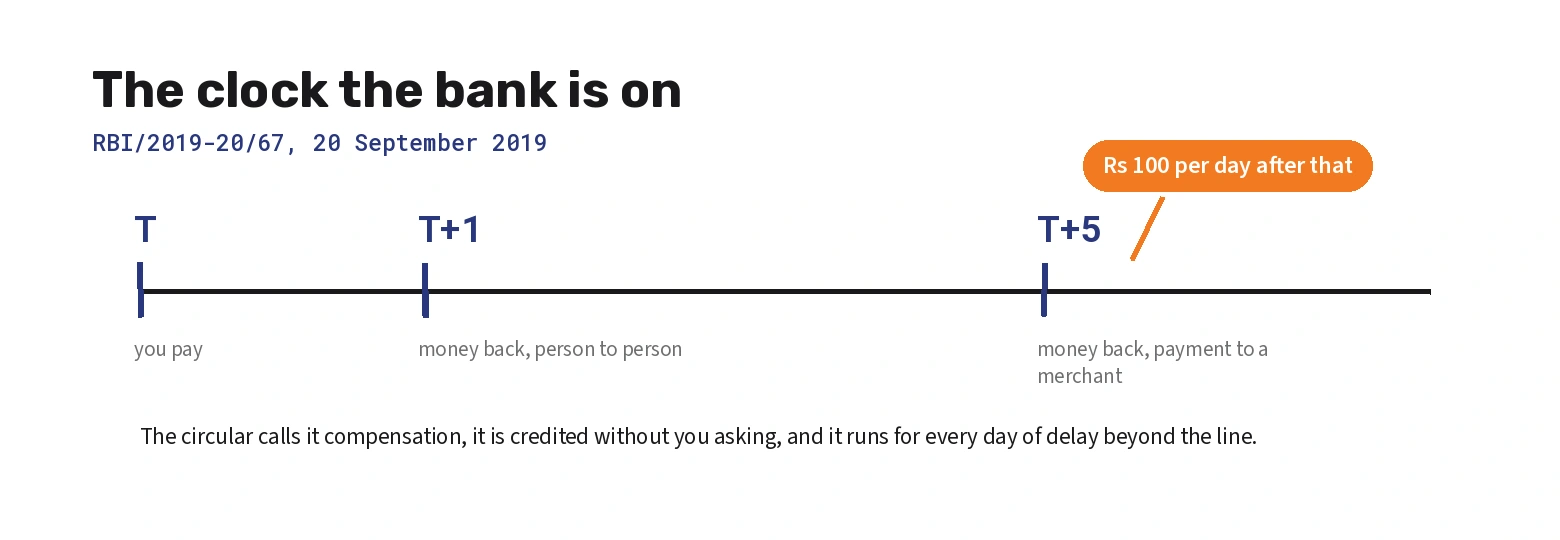
The beneficiary bank auto-reverses «latest on T + 1 day». Beyond that the circular sets Rs 100 per day of delay.
- Debited with no confirmation, paying a shop
Auto-reversal within T + 5 days, and the same Rs 100 per day after it.
- Pending is not the same as failed
Their own answer: the transaction is successful and the delay sits at the beneficiary bank. Nothing about that is a reason to pay twice.
Where a complaint actually goes
Two steps, in that order, and the second one has a name and an address.
- Start inside the app of the participating bank
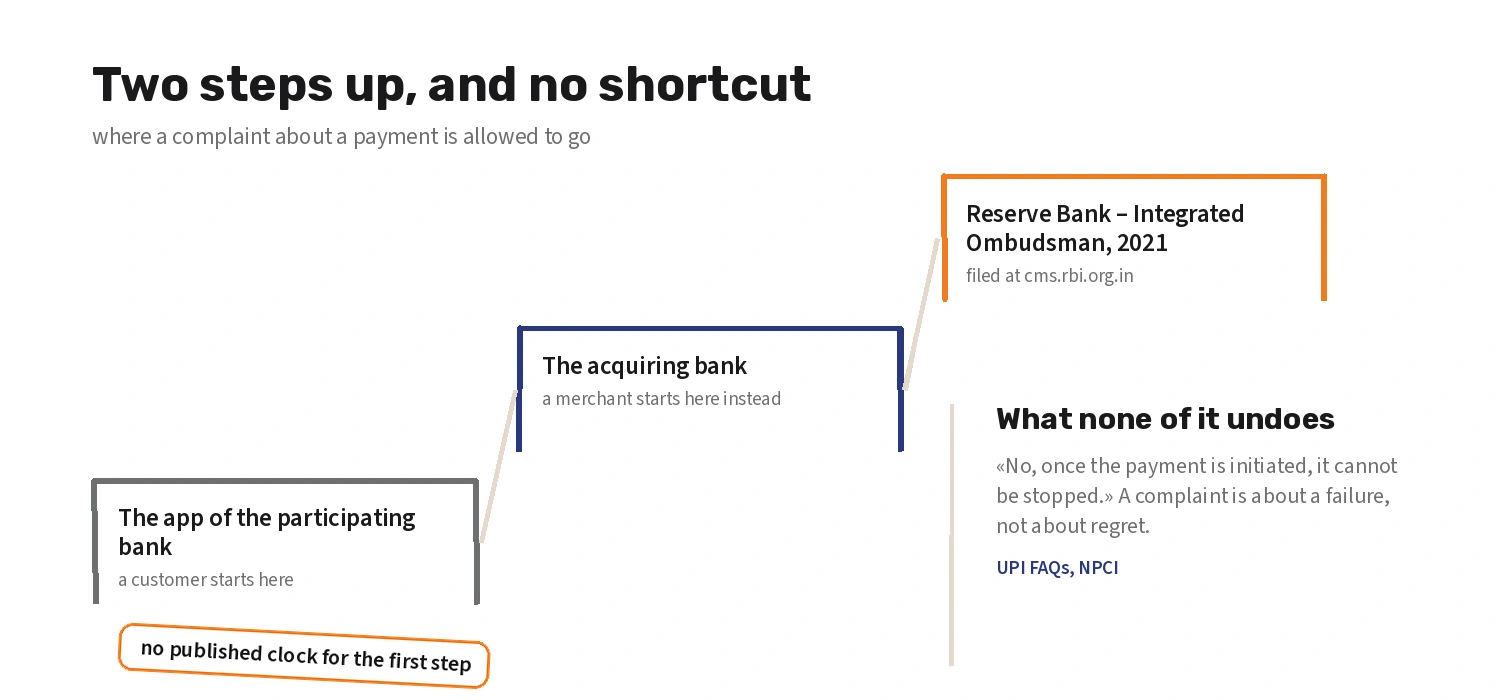
That is where NPCI sends a customer: raise the grievance, or check the status of the transaction, through the UPI app itself. A merchant goes to the acquiring bank instead.
- Then the Reserve Bank
The Reserve Bank – Integrated Ombudsman Scheme, 2021, amended in 2022, is the route above the bank. Complaints are filed at cms.rbi.org.in.
- What is not published is the clock inside the app
No page open to read states how long the in-app step is allowed to take. Anyone quoting a number for that is quoting something else.
- And a payment still cannot be recalled
«No, once the payment is initiated, it cannot be stopped.» A complaint is about a failure, not about regret.
Six checks that take less time than the payment
Three concern UPI and three concern the operator. They are the ones worth doing before the money moves rather than after.
-
01
The ceiling that applies to this payment
Rs 1 lakh is the ordinary one. Higher tiers exist only for the categories NPCI lists, and your bank can sit below all of them.
-
02
That a payment cannot be pulled back
NPCI is blunt about it: once initiated it cannot be stopped. What exists is the reversal window, not an undo button.
-
03
The date, if the money has not arrived
RBI sets T+1 for a transfer and T+5 for a merchant payment, and Rs 100 for every further day. Count the days before you call.
-
04
The bank message, not only the app screen
A success screen inside an app is a screen. The debit is what your bank tells you, and that is what a dispute is argued from.
-
05
The minimum the operator itself asks for
Every casino publishes its own floor in its own cashier. That number overrides anything written anywhere else.
-
06
That the account is in your own name
Almost every operator requires the payment instrument and the gaming account to belong to the same person before a withdrawal.
The links in this section are sponsored. No operator is named here because cashier rules change without notice: the list that counts is the one inside the casino itself.
Limits, failures and the paperwork after
Is there one UPI transaction limit?
No. NPCI publishes Rs 1 lakh per transaction for normal UPI, Rs 2 lakh for categories such as capital markets, collections, insurance and foreign inward remittances, and Rs 5 lakh for an initial public offering and the retail direct scheme.
Who decides these figures?
NPCI, by circular. Its own circular index lists separate instruments for the two lakh tier, for the five lakh tier and one headed as a revision of limits based on merchant and transaction types.
How much can I send in a single day?
No rupee figure for ordinary UPI appears on any published page. The only daily figure NPCI names is Rs 1,00,000, and that is for UPI 123PAY on feature phones. For everything else the ceiling belongs to your bank.
Money left my account and never arrived. How long do I wait?
For a transfer to a person, the beneficiary bank has to reverse it by T+1 at the latest. For a payment to a merchant, the auto-reversal window is T+5.
Is anything owed to me if it takes longer?
Yes. RBI circular RBI/2019-20/67 sets Rs 100 for every day of delay beyond those deadlines, and calls it compensation rather than a refund.
My payment says pending. Is that a failure?
Not according to NPCI. Their answer is that the transaction is successful and the delay sits at the beneficiary bank end.
Can a payment be cancelled once it has gone?
No. Their wording leaves no room: once the payment is initiated, it cannot be stopped.
Where do I complain if the bank does nothing?
First through the UPI app of the participating bank, or, for a shop, through its acquiring bank. Above that sits the Reserve Bank – Integrated Ombudsman Scheme, 2021, with complaints filed at cms.rbi.org.in.